Eduphoria districts can choose between two versions of the T-TESS framework: T-TESS Alternate Domain 1 (ALT D1) and T-TESS v2.
Note: This article walks you through setting up a form for a T-TESS ALT D1 evaluation process. When you are ready to conduct an evaluation, see Creating an Evaluation Document for staff.
T-TESS ALT D1 Framework
According to the TEA, some districts currently utilize a variety of curricula that shift teacher responsibilities from lesson planning to lesson internalization. Rather than designing lessons, teachers internalize and adapt content for already-created lesson plans.
In 2024, the TEA released an alternate Domain 1 focusing on lesson internalization rather than planning. Starting with the 2024-2025 school year, teachers may be appraised using Domain 1 or Alternate Domain 1, depending on whether a teacher’s responsibilities align with lesson planning or internalization.
Eduphoria has created a framework for this option, T-TESS ALT D1. It is available to all customers and appears in the frameworks list.
Identifying Locked Frameworks
Appraisal managers can access locked frameworks by selecting Settings (), then Framework Setup.
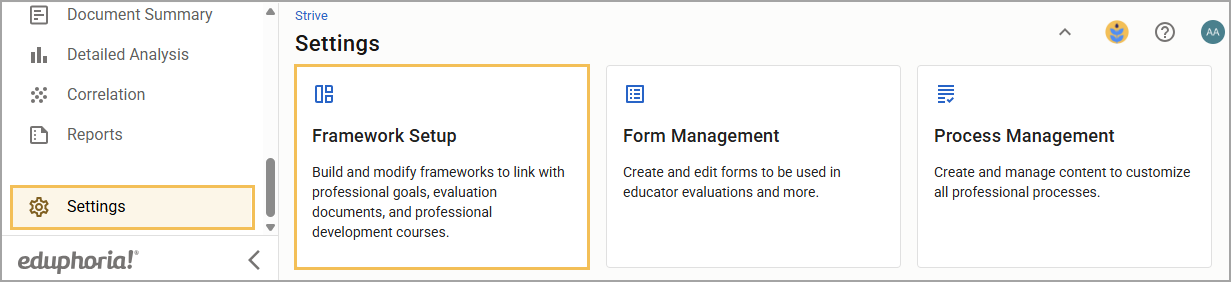
Locked frameworks are indicated with a Lock icon () and cannot be edited or deleted.
.png)
A locked framework called T-TESS ALT D1 is a rubric from the TEA with an alternate version of Domain 1 for teachers who use packaged lesson plans. If your district selects this framework, you must create a new evaluation process to help maintain access to historical data tied to the old framework. Learn more about building the evaluation process with the T-TESS ALT D1 framework.
Note: Eduphoria recommends that you select one framework for all teachers so the data will not be split between two processes. Select ALT D1 only if you evaluate all of your teachers using the language of lesson internalization. If you have a mix, select the v2 framework and address lesson internalization by using the documents that have descriptors for both (see the table in Step 3 under Verifying Prebuilt Forms below).
Building the Evaluation Process With the T-TESS ALT D1 Framework
If your district uses the locked T-TESS ALT D1 framework, you must build a new evaluation process.
Retiring Your Existing T-TESS Process
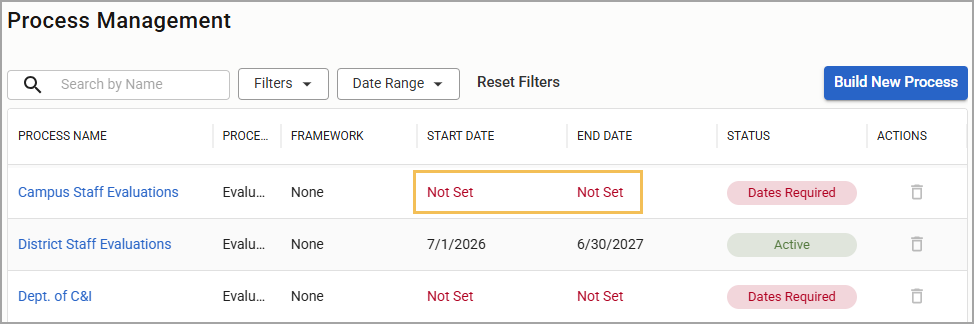
The first series of steps requires you to retire your existing T-TESS process.
Do not delete existing process. Leave the Start Date and End Date fields as Not Set, indicating that the process is inactive. An inactive process cannot be assigned to users.
Note: Evaluators will need to select their staff and assign a new evaluation process.
Verifying Prebuilt Forms
Next, you must locate and verify that you have prebuilt forms from Eduphoria.
Quick Guide
Select Settings (), and then select Form Management.
Select the Prebuilt Forms tab.
Select each form type and verify that you have each of the following forms in the table:
Reflections
T-TESS ALT D1 - BOY - Self-Assessment (GSPD Part I)
T-TESS ALT D1 - EOY - Goal Reflections (GSPD Part II)
Walkthroughs
T-TESS ALT D1 Walkthrough, Domains 2&3 Look Fors
T-TESS ALT D1 Walkthrough, Domains 2&3 Comment Boxes
T-TESS Alt D1 D2-3 Ratings NEW
T-TESS Alt D1 Domains 2&3 (Checklists & Ratings) NEW
Observations
T-TESS Alt D1 Pre-Obs. Conference
T-TESS Alt D1 Observation
T-TESS Alt D1 Observation (grouped)
T-TESS Alt D1 Post-Obs. Conference
Summatives
T-TESS Alt D1 Summative
T-TESS Alt D1 Summative (grouped)
If any are missing or don’t appear properly tagged, contact Support.
Illustrated Guide
Step 1: Select Settings (), and then select Form Management.
.png)
Step 2: Select the Prebuilt Forms tab.
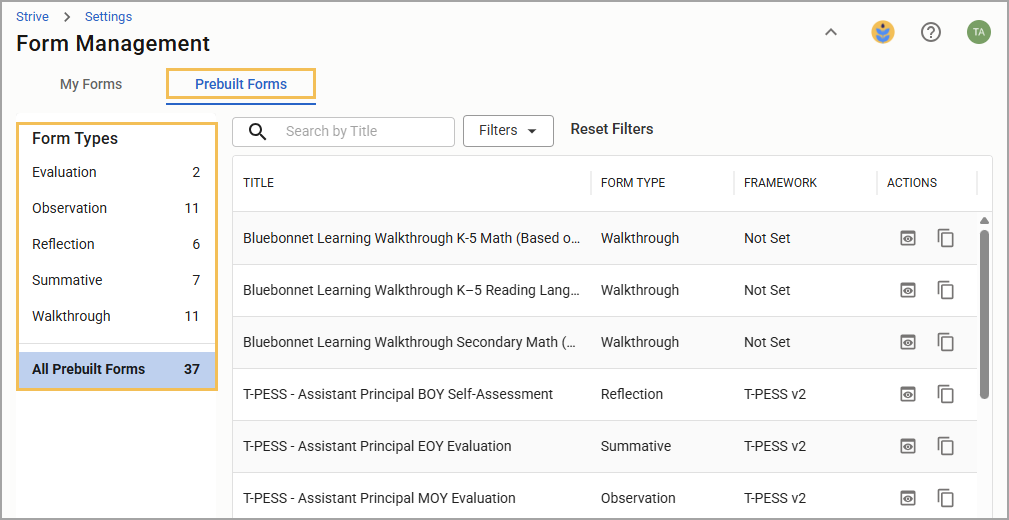
Step 3: Select each form type and verify that you have each of the following forms in the table:
Form Type | Form Title |
|---|---|
Reflections | T-TESS ALT D1 - BOY - Self-Assessment (GSPD Part I) T-TESS ALT D1 - EOY - Goal Reflections (GSPD Part II) |
Walkthroughs | T-TESS ALT D1 Walkthrough, Domains 2&3 Look Fors T-TESS ALT D1 Walkthrough, Domains 2&3 Comment Boxes T-TESS Alt D1 D2-3 Ratings NEW T-TESS Alt D1 Domains 2&3 (Checklists & Ratings) NEW |
Observations | T-TESS Alt D1 Pre-Obs. Conference T-TESS Alt D1 Observation T-TESS Alt D1 Observation (grouped) T-TESS Alt D1 Post-Obs. Conference |
Summatives | T-TESS Alt D1 Summative T-TESS Alt D1 Summative (grouped) |
Note: Framework settings and tags are already set for prebuilt forms.
Step 4: If any are missing or don’t appear properly tagged, contact Support.
Building a New T-TESS ALT D1 Process
Next, you’ll build a new T-TESS ALT D1 process.
Quick Guide
Select Settings (), and then select Process Management.
Select Build New Process.
Type “T-TESS Teacher ALT D1” in the Process Name box.
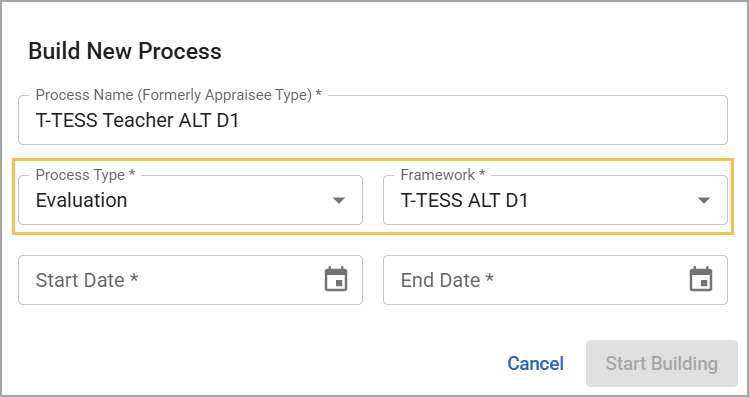
Set your Process Type as Evaluation and your Framework as T-TESS ALT D1.
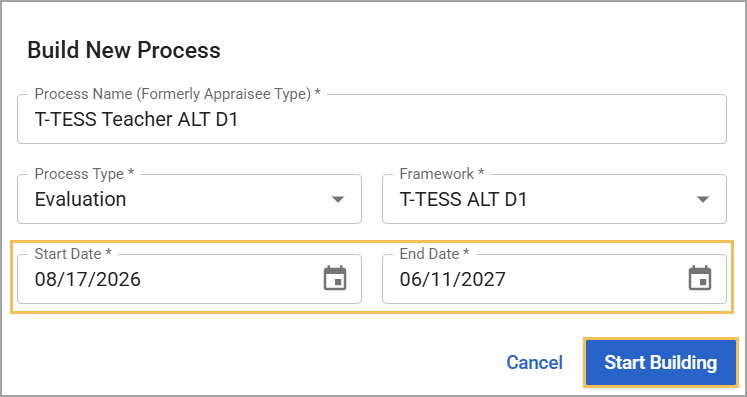
Set the Start and End Dates of the process, then select Start Building.
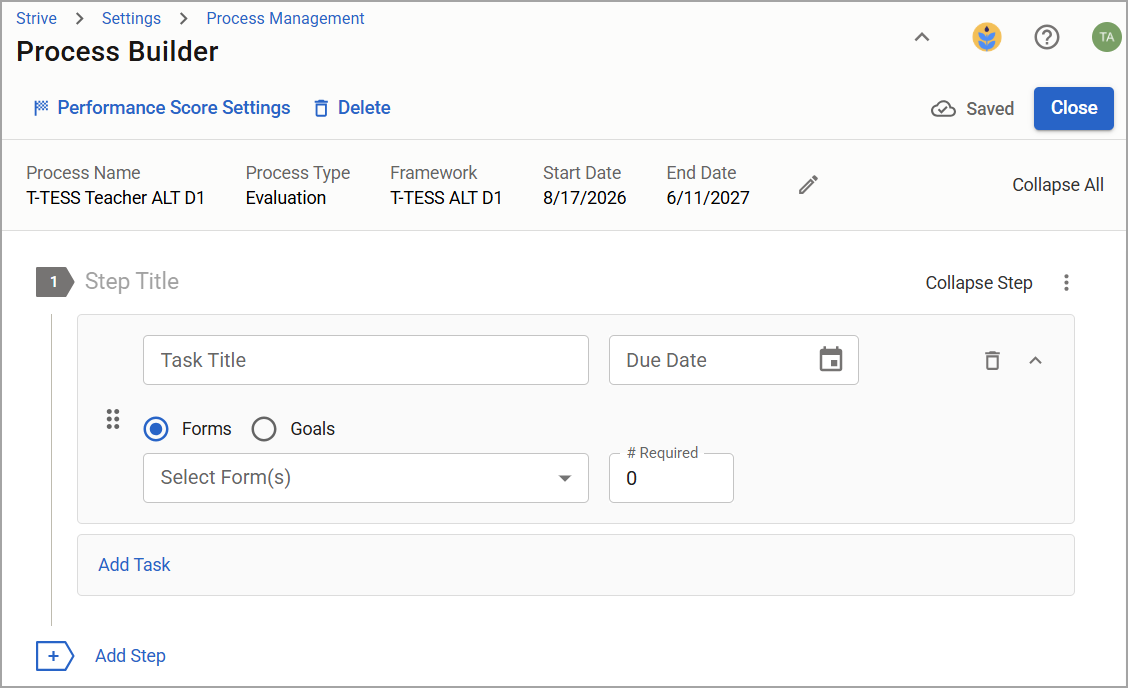
Set up the evaluation process by creating and modifying steps and tasks.
Assign Forms or Goals to each task as you create them (see a sample process in Step 7 of this section’s Illustrated Guide).
For Forms tasks, attach the appropriate form (see a list of recommended forms in Step 8 of this section’s Illustrated Guide). Set the number required to complete and a due date for completion to help evaluators monitor their staff’s progress in the Overview and Activity Tracker.
Illustrated Guide
Step 1: Select Settings (), and then select Process Management.
.png)
Step 2: Select Build New Process.
.png)
Step 3: Type “T-TESS Teacher ALT D1” in the Process Name box.
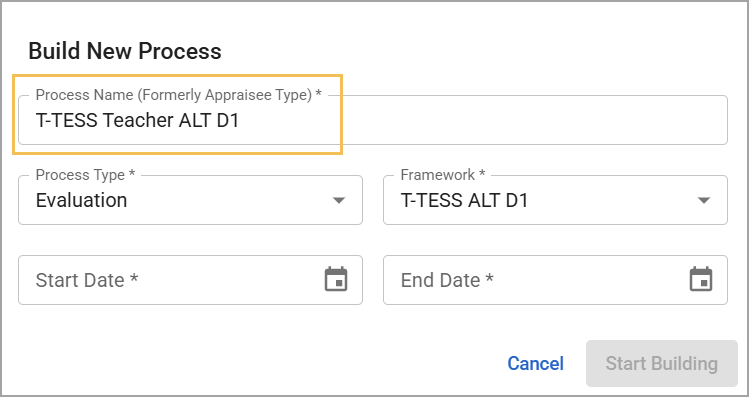
Step 4: Set your Process Type as Evaluation and your Framework as T-TESS ALT D1.
Step 5: Set the Start and End Dates of the process, then select Start Building.
Step 6: Set up the evaluation process by creating and modifying steps and tasks.
Step 7: Assign Forms or Goals to each task as you create them.
Sample Process
Step Title | Task Title | Task |
|---|---|---|
Goal Setting | Self-Assessment | Form |
Professional Goal | Professional Goal | |
Student Growth Goal | Student Growth Goal | |
Walkthroughs | Walkthroughs | Form |
Observation | Pre-Observation Conference | Form |
Observation | Form | |
Post-Observation Conference | Form | |
End-of-Year Conference | Goals Reflection | Form |
Summative | Form |
Step 8: For Forms tasks, attach the appropriate form. Set the number required to complete and a due date for completion to help evaluators monitor their staff’s progress in the Overview and Activity Tracker.
Note: For data collection purposes, Eduphoria recommends that you select only one walkthrough form as your primary for the required T-TESS Walkthroughs task. Other forms can be used in a separate task.
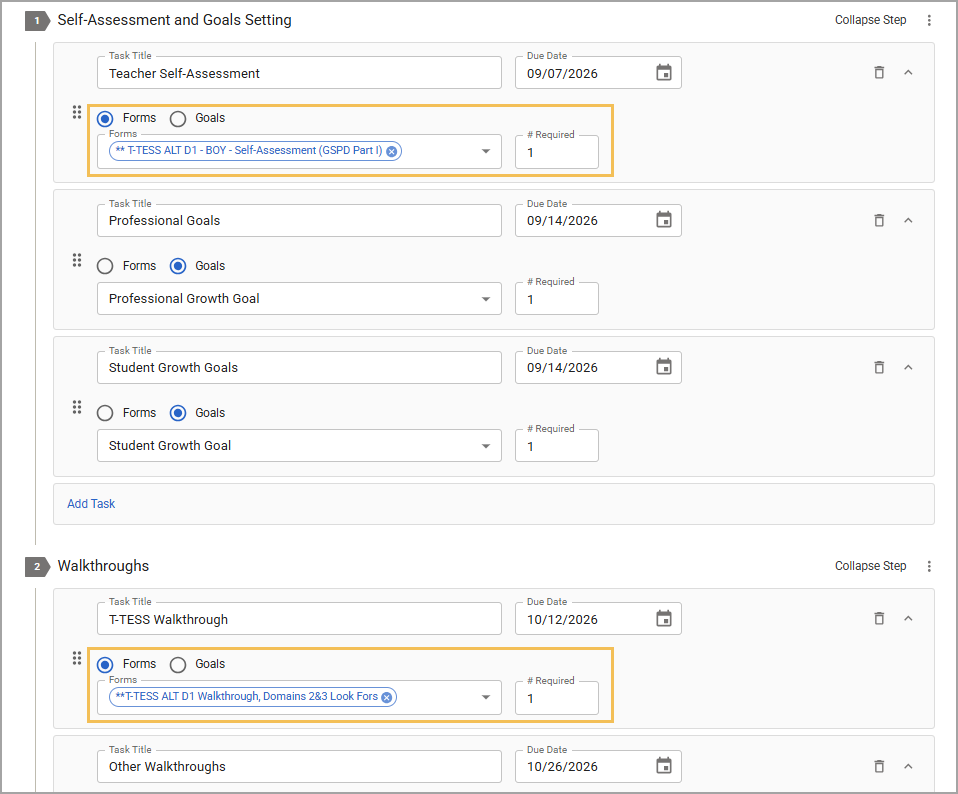
Recommended Forms
Step Title | Task Title | Form Type | Form Title |
|---|---|---|---|
Goal Setting | Self-Assessment | Reflection | T-TESS Alt D1 - BOY - Self-Assessment (GSPD Part I) |
Walkthroughs | Walkthrough | Walkthrough | T-TESS Alt D1 Walkthrough, Domains 2&3 Look Fors |
Walkthrough | T-TESS Alt D1 Walkthrough, Domains 2&3 Comment Boxes | ||
Walkthrough | T-TESS Alt D1 D2-3 Ratings NEW | ||
Walkthrough | T-TESS Alt D1 Domains 2&3 (Checklists & Ratings) NEW | ||
Observation | Pre-Observation Conference | Observation | T-TESS Alt D1 Pre-Obs. Conference |
Observation | Observation | T-TESS Alt D1 Observation | |
Post-Observation Conference | Observation | T-TESS Alt D1 Post-Obs. Conference | |
End-of-Year Conference | Goals Reflection | Reflection | T-TESS Alt D1 - EOY - Goal Reflections (GSPD Part II) |
Summative | Summative | T-TESS Alt D1 Summative |
Your new T-TESS ALT D1 process is now ready to use. Evaluators must select the T-TESS ALT D1 process for the teachers they evaluate with this framework.
Making Old Forms Inactive
Form Management contains all active forms and allows appraisal administrators to make them inactive. Making a form inactive moves it to the Inactive Forms section, removes it from processes and report selections, and maintains historical data for analysis. In addition, you can reactivate inactive forms.
Locate the old form under the appropriate form type, then select the Make Inactive icon.
.png)
If the Make Inactive icon is grayed out, that means the form is currently associated with a process and cannot be made inactive.